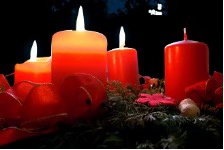
As we write this just before the third Sunday in Advent, Gaudate or Rejoice Sunday, when we light the pink candle, we remember that Advent is a time of waiting and anticipation. We are waiting with Mary for the birth of Jesus, his first advent, and waiting with Isaiah and others in the Hebrew Scriptures and with Jesus’ Church after the Ascension for his second advent, which is always “at the door,” since he is in the timeless “now” of God. We greet you in this double time of waiting.
Last Advent on Dec 19, 2024, Peter celebrated 10 years as a Catholic priest, the milestone that was on his heart when he was ordained. Every day more than that is a bonus from God for which he is thankful.
The baseline of the last year has been the steady rhythm of ministry here at Our Lady of Guadalupe Priory. Peter has the daily celebration each morning, 6:30 am on weekdays and 7:30 on weekends, year round except when the Sisters are away, which is about three weeks a year. Then he hears confessions every Friday. This fits with the rhythm of his 5 times of daily prayer and scripture meditation, the Liturgy of the Hours, in which Judy joins him for Evening Prayer and then Night Prayer before bed.
For the last two years, until June 22nd of this year, Peter has been one of two priests helping the Austin Ordinariate community of Sts Peter and Paul Catholic Church to get going. Since we were closer to where it was meeting, we were there almost every week. That has now changed because since June 29 the community has a part-time pastor who also serves the Diocese of Austin part-time. The community has kept growing and going under his leadership and expects to move into a converted commercial building on Jan 4. Being a part of a new church launch is quite fulfilling for us.
That is good since we have both struggled with some significant illnesses over the year. Judy has had continuing respiratory issues that flared up twice when infection set in, once in the fall and once last month. She is also dealing with congestive heart issues, difficulty in walking, and balance (three or four falls within the year). Peter had triple hernia surgery in February and was struggling with tiredness and dizziness to the point that he wondered if he would make it through his final services at Sts Peter and Paul. He did go to a St Paul Center Priests’ Conference for his annual retreat in April, but left early after a suspected TIA. In June he got at least part of the answer when our GP discovered he had severe anemia. In July he started treatments with a hematologist at Texas Oncology, and several iron infusions later his hemoglobin levels are above the minimum, although the cause was never found and the hematologist is not convinced that his hemoglobin levels will stay normal. This reminds us that we are likely to go to meet Jesus before he returns. It is a good practice to remember one’s death (memento mori) so that one is always ready for that.
On a less challenging note, we have had a series of visitors. Rev Larry Eastman visited in January. Then we had two visits from leaders in the Brothers and Sisters of Charity, our former regional leaders Daryl and Lori Nagel in January and the founder and leader of the movement, John Michael Talbot and his wife Viola in September (he was doing concerts at a local parish). Peter has continued leading a BSCD cell group via Zoom and both of us do spiritual direction via Zoom for members and former members of the BSCD scattered around the country. We also had a several day visit from our daughter Elaine and her husband Greg (thanks to a business conference Greg had in Austin) in October during which Judy’s sister and her husband visited briefly. Earlier in October Peter went to the Ordinariate’s Annual Priests’ Convocation which this year was in San Antonio and included a pilgrimage to the early missions in the area. That was physically exhausting but spiritually refreshing.
Peter did see the completion of one project, for his most recent scholarly article was published in David B Capes’ book Does It Matter Who Wrote the Bible? (Pickwick Publications, 2025)
So, we continue our basic ministries here, Peter at the Priory daily and Judy doing spiritual direction and pastoral counseling via Zoom and other media on Wednesday and Fridays, but Peter, at least, has drawn back some from outside ministry to spend more time in prayer. He believes that his age 80 is the outside limit for continuing ministry here (Judy turned 81 in Oct and Peter 78 in Nov) and likely we will transition sooner. Our son has just closed on a house in Abbotsford, BC Canada, that has a grandparents suite and that seems the most viable option especially since it positions us for relationship with and support from family as we continue to age. We will see what this next calendar year brings.
As we noted above, Advent is a time of waiting, waiting with Mary for the first advent of Jesus, waiting with the church for his second advent, preparing our hearts and lives for the daily presence of Jesus within, and the manifest presence of Jesus when he comes into this world of violence, conflict, and confusion. That is what gives us peace even when there seems to be little peace on earth right now.
In our Lord,
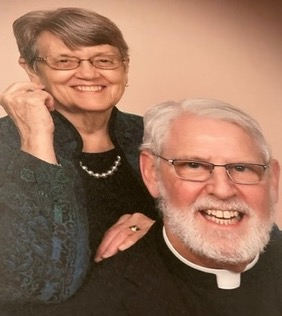
Peter and Judy Davids
Contact us at: phdavids@gmail.com or jldavids@me.com or 713-314-7886 (P) 832-398-9519 (J) or 5499 E State Highway 29, Georgetown TX 78626
Within the evangelical world there have been numerous leaders or pastors crashing due to sexual, spiritual, financial, or emotional abuse of others, often members of their own church or ministry. While the issue of sexual abuse in the evangelical world is not new (my wife, a clinical counselor, encountered many cases of it back in the 1990’s), the number of high-profile pastors and leaders who has crashed (or ended up in unbelievable denial) is certainly a new phenomenon, partly created by independent journalists and social media presences that will not allow the issues remain private and partly because even without the call-out culture one cannot remain private in a linked world that is becoming increasingly intolerant of sexual abuse and of toxic workplaces. But even more significant than the high-profile nature of many of those who crash is that many of them are either “charismatic” or what I call semi-charismatic (exhibiting a leadership style similar to the charismatic leaders but without direct claims to specific “charismatic” gifts, such as “speaking in tongues”). Why might this be so? Let me lay out some observations I have made that point to points of vulnerability. This will be brief, a sketch rather than a thorough examination, but it should give us some food for thought.
First, there is a lack of formation.
Many of these pastors and leaders either had no formal training, having “risen through the ranks” from committed young member to, say, part of the team leading the youth group or the worship ministry to youth pastor or some other pastoral role or perhaps branching out into a parachurch ministry of their own. Their training was through copying a mentor or mentors and perhaps reading the Bible and some books, especially those on practical theology and spiritual gifts. There is little theological depth and virtually no historical perspective. They do not know how to critique the theology of their mentors and certainly have had little in the area of ethics or character formation. They may even boast of their lack of formal education claiming that the Bible and the Spirit are all they need, for they are “God’s man (or woman)” or “God’s anointed.”
Many of the rest have gone to traditional seminaries that gave them a lot of Bible and biblical theology (which included some systematic theology) with limited church history and practical theology, but with little or nothing in the area of ethics, spiritual formation (such as prayer), and human formation. Contrast that with a seminary program in which the seminarians live together in a dorm, have prayer times together two or more times per day, have daily worship, and are overseen by a formator who is interested in their character development and human interactions. In such communal seminaries they likely have a spiritual director who in confidence helps them process their relationship with God.
In the first group the budding leader is likely to reproduce the weaknesses of their mentor, perhaps weaknesses that the mentor has no idea he (or she) has, and that same budding leader may be criticized for any admission of spiritual struggles. In the second group the head may be filled, but human and spiritual formation are not the usual result of the typical papers and exams which are the seminary’s window into the seminarian. Furthermore, especially with many schools now going online, there may be no one in the institution who really knows them. That was not the type of seminary that Charles Borromeo envisioned in first starting such institutions.
Second, there is a focus on the wrong gifts of the Spirit
The Pentecostal movement introduced a focus on the 1 Cor 12 gifts of the Spirit which was brought into the wider Protestant and Catholic world through the neo-Pentecostal movements. (There are, of course, other charismatic movements, such as the contemplative Rufer Bewegung that I experienced in Germany in the 1970’s that would be immune to these critiques.) These, of course, are the ministry gifts needed for the already-formed-and-functioning Church to explode out of a waiting posture in Jerusalem where it was a Jewish sect into the wider world of the Roman Empire and beyond. Significantly the “go” signal in the form of empowerment by the Spirit was given when people from across the Roman Empire and its environs were gathered to Jerusalem. The emphasis in Acts 2 is on all those gathered hearing the good news in their own languages. Thus “speaking in tongues” means speaking in (to the speaker) foreign language(s), which is the normal meaning of the term in Greek and how the term is understood in Patristic writings. That is why in the New Testment “speaking in tongues” is forbidden in the gathered community unless there is a translator present (1 Cor 14 – and there does not seem to be the expectation that this would normally be the case; it would also be awkward to speak with interruptions for translation when one could simply speak in the local language). In other words, Paul goes to great lengths to point out that (1) all do not speak in tongues (= foreign languages), (2) love is the spiritual gift that one wishes and which trumps any of the ministry gifts, and (3) speaking in tongues in particular is not a mark of spiritual maturity.
Of course, it was assumed in the early appearances of the modern phenomenon of speaking in tongues in Topeka Kansas and Azuza Street that the people were speaking in actual foreign languages. In fact, they often named the (sometimes extinct) language in which they were speaking. But it became clear both when linguists listened to the phenomenon and when the phenomenon did not enable missionaries to communicate in places to which they believed God had sent them that this was not language but ecstatic speech, either as a group phenomenon or as a private “prayer language.” Now such a phenomenon of ecstatic language is found in Scripture in 1 Samuel. In 1 Sam 10:5-6 Samuel prophesies that the newly anointed Saul with eventually meet a “band of prophets” coming from a Philistine occupied city playing all sorts of instruments and prophesying. Before that, in 1 Sam 9:9, we have already been informed that what was called a prophet (nabi’) in most of the Hebrew Scriptures was at the time of Samuel called a seer (ro’eh). Here in 1 Sam 10:5-6, and the subsequent narrative when Samuel’s prediction is fulfilled, we are introduced to what in those days was called a prophet, namely a person upon whom the Spirit came, often when accompanied by music and processing or dancing, who spoke in ecstatic speech. In the case of Saul, he falls to the ground as he prophesies. Also in the case of Saul, there is a later occasion when this happens to him without music and as a type of shaming from God. The verb for prophesying that is used for both the band of prophets and for Saul is, interestingly enough, used in a reflexive form that is not used for later prophesying. Thus, we have here a phenomenon very similar to the phenomena of neo-Pentecostal “speaking in tongues,” whether individual or collective (with music). It is said to be caused by the Spirit, although in 1 Kings 18:26-29 the same phenomenon (including the same form of the verb to prophesy) is said to be typical of the Ba’al prophets, so one must be careful about which spirit is influencing one.
Aside from setting the record straight on “speaking in tongues,” the point above was that the emphasis on what one might call the missional gifts of the Spirit, which are not universal and do not demonstrate spiritual maturity, is problematic. It may make one think that one is more spiritually advanced than one is rather than that one is simply using a ministry “tool” that the Spirit may give to anyone with greater or lesser frequency according to how often he assigns them a task to do that requires the “tool.”
The far more important gifts of the Spirit, what Jesus is talking about on and off in John 13-17 and granting in John 20, are those of Isa 11:2-3: “And the Spirit of the Lord shall rest upon him, the spirit of wisdom and understanding, the spirit of counsel and might, the spirit of knowledge and the fear of the Lord. And his delight shall be in the fear of the Lord.” (In the Septuagint the first “fear of the Lord” is eusebeia or piety, a virtue). We see these gifts granted to Jesus in the coming of the Spirit upon him in his baptism equipping him for sacral kingship, although only some aspects of these are named, particularly wisdom. With these he is enabled to do combat with the devil in the wilderness. These, then, are what are often referred to in the epistolary literature as important for Christians (e.g. Eph 1:17 and 1 Pet 4:14 with “might” being understood as “fortitude” or “patient endurance” as it was in the Patristic tradition). They are experienced by others as the “fruit of the Spirit” of Gal 5:22-24, the virtues flowing from the Spirit within. When it comes to leaders (presbyters or bishops), whether it be in 1 Tim 3 or Titus 1, it is such moral qualities that are stressed, not functional ministry gifts. In other words, these gifts of the Spirit make one like Jesus with the virtues that he possessed; maturity in that virtue is what one wants in a leader.
This flowed into the Patristic tradition, as we see in St Greogry the Great, Homilies, 2,7,7, among many other uses of the virtue tradition, and was systematized by St. Thomas Aquinas, again, as the first among many others. These are the basis of the virtues that one might pray for daily, which virtues (or lack thereof) are the basis for a good self-examination at the end of the day. For such a synthesis in contemporary context see https://openlightmedia.com (e.g. their School Starter Kit). Failure to focus on these gifts of the Spirit and the virtues that they produce leaves a person vulnerable.
Third, there is a desire for power and influence
Along with virtues there are vices. The seeking of the charismatic spiritual gifts can easily degenerate from using a tool to get the Lord’s work done to seeking power, perhaps to convince oneself of the presence of God in one’s life (the opposite of the virtue of faith) or perhaps to gain status in a group or gain influence over others. This, of course, is opposite of the virtue of humility. Along with power there is the seeking of honor, invitations to speak at “important” conferences or come to “important” meetings, special titles such as “the prophet x” or the “healing evangelist” or the like. Some of these start off as merely descriptive but inflate the ego with which they become identified. All of this is seductive, as Jesus says of the Pharisaic scribes who “seek the best seats in the synagogues” and the like (Matt 23:6-7). In other words, pride has crept in. We can also see this in a person talking about their exploits, the people “they” have healed or the numbers who were converted in their church or in a special event in a stadium. Jesus and the others in the New Testament usually tell those healed or otherwise helped to tell no one. And with such giving in to passions for power and honor two others are close, the desire for money or goods (that can be an attempt to satisfy the need for security or an attempt to impress others) or greed (and envy of those who have more) and the desire for sexual love beyond the bounds of marriage in which love should be seeking the good of other rather than self-gratification. Sometimes this drive includes other pleasures as well. Of course, sexual intimacy in such extra-marital contexts is often not about sex, for it can be a desire to control and dominate others or to gain a “trophy.” So sexual adventures can be pride or power exercises as well as or rather than being the sex drive gone amuck. Whatever the vice, Scripture has nothing good to say about sex outside of marriage (and even within marriage it may become domination rather than love).
Now often a sexual transgression is where a person is said to “fall.” It may then be ignored or the weaker partner may be blamed for “seducing” the great pastor. But once it becomes undeniable it usually requires at least an apology. This is not the case with the other vices, for wealth may be described as “the blessing of God” and a “sign of divine favor.” Healing fame may be attributed to holiness with people hungry to hear the stories, basking in the reflected glory. Pride in or in following such a leader may be thought of as an appropriate perk of “the Lord’s anointed.” That makes the followers of such a leader codependent supporters of the leader. And all are blind to the vices they have fallen into, for they have never been formed or schooled in the language of virtue and the danger of vice, let alone the psychology that underlies parts of the discussion above.
In other words, what I am arguing is that proper formation that includes spiritual direction and instruction in virtue that is experienced in the context of community is necessary for healthy, humble, self-aware church (or religious organization) leadership. The lack of such formation and the emphasis on the 1 Cor 12 gifts of the Spirit that have nothing to do with character but rather are tools for outward focused ministry leaves such leaders vulnerable. And in a church and secular culture that views power, pleasure, honor, and wealth as signs of success or, in the church, God’s favor, rather than dangers, such leaders are set up to fall into the more vicious forms of these dangers, unprotected by ongoing spiritual direction and regular self-examination of conscience. That Protestant culture (as well as secular culture) is very individualistic leaves the leader isolated. Thus they crash and are left to stich their life and ministry back together, often without thorough self-examination in the context of the great spiritual tradition and sometimes without counseling help either.
There is more that one could say about the authority structures that are lacking and why this can also happen (but usually not as spectacularly) in Mainline Protestant and Catholic contexts (see, for instance, Pope Benedict XVI’s essay “The Church and the Scandal of Sexual Abuse” in his posthumous book What Is Christianity? The Last Writings), but I will leave some of that for another blog post on the call-out culture and the problem of individualism and authority.
This past year has marked our fifth year living in Mission House at Our Lady of Guadalupe Priory and Peter’s serving as chaplain for the Sisters. This is the longest we have lived in one house. It also marked the end of Judy’s 80th year, Peter’s 77th year, and the 10th year of Peter’s priesthood.
Of course, as is typical of this age of waiting for the second advent of our Lord, this has been a year of bidding farewell to friends and former students who have already preceded us into the presence of our Lord. We have had our health struggles, Judy with her right knee and also her lungs, which have made travel difficult, and Peter with night driving and finally solving the problem of dizziness (bright lights, especially ones that blink, affect him, so he wears FL-41 lenses in such situations), but it looks as if we have a ways to go on our earthly journey yet, although we have no certainty of how much longer that journey will be.
Peter has continued his chaplain ministry for the Dominican Sisters, as well as his assisting with the new Sts Peter and Paul Catholic Church, a vibrant Ordinariate community-in-formation in west Austin. He ended his ministry at the Austin Byzantine Catholic Community in May, at least for a while, because it kept him out too late at night. He has helped with other parishes in our area and remains for now as chaplain for the local Knights of Columbus council. Judy continues her spiritual direction calls, zooms, and meetings on Wednesdays and Fridays. We also lead the small Austin area cell group for the Brothers and Sisters of Charity, Domestic.
Our year was marked with three special events. First, instead of Peter’s making his usual silent retreat he was able to arrange to take Judy with him in April to a conference style retreat in the Austin area by the St Paul Center for Biblical Theology. This obliviated the need to find someone for Judy to stay with/ stay with Judy. That was our first visit to the lake area west of Austin. And we got to see the solar eclipse.
In July we flew to Calgary where much of our family was gathering for our eldest daughter’s birthday. We had not seen some of the grandchildren in years. This coincided with the Sisters being away from the Priory so Peter had the time off. The exciting part was airline issues on the return trip, including Judy’s being literally raced in a wheelchair between gates in Denver. But we made it, and Peter was able to celebrate masses that Sunday back in the Austin area.
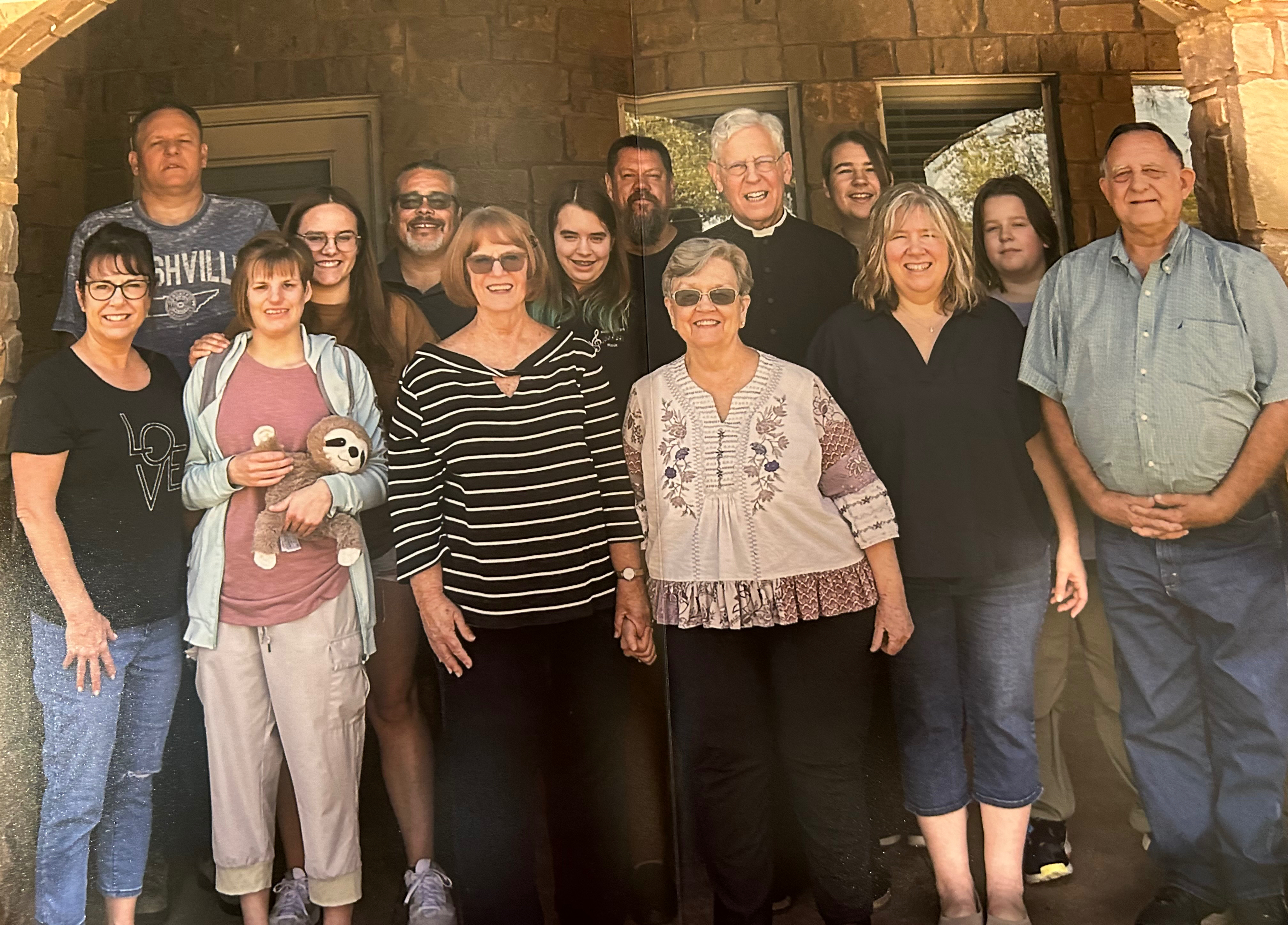
In October again much of our family gathered in Georgetown for Judy’s 80th birthday. As in the case of Elaine’s birthday, it was a surprise. (And Peter had not been able to say “no” to the Calgary trip because he would have had to give away the surprise October gathering.) This included not just our immediate family, but also Judy’s sister and husband and a cousin and his wife and also two of Judy’s church girlfriends from her childhood/teen years. (See the picture above)
And now we are in the middle of Advent, focusing on the birth of our Lord two millennia ago, his coming to each of us in our present lives (seen with our spiritual eyes), and his climactic coming at the time of his choosing when all is ready to gather his people and transform the creation. Thus, even though we live in a time of great struggle and turmoil (both Judy and Peter have former students who are Ukrainian and suffering from the conflict there either as refugees or as a pastor serving a congregation in the midst of missiles flying nearby) with 2025 looking like it will be more rather than less tumultuous, we live in hope, for we live in a love relationship with the One who will ultimately finish history and know it will be good, it will be very good, all manner of things will be good.
May God’s blessing rest upon you this Advent, this Christmas, and in the coming year.
In our Lord
Peter and Judy Davids
Please note that our address is:
5499 E State Highway 29; Georgetown TX 78626 (some friends still have an older address for us)
Our phones are +1 713-314-7886 (Peter) and +1 832-398-9519 (Judy); Our emails are phdavids@gmail.com and jldavids@me.com
Anger is a power emotion, the “fight” of the fight or flight due, associated with the general activation syndrome. It is well known that anger is a dangerous emotion, for unlike its usefulness in confronting a lion or a bear in which is gives one focused vision and increased strength, when it comes to human enemies that is useless unless one is locked in physical combat. Without that expenditure of energy anger, including in its less outward forms such as resentment or smoldering rage, is both psychologically habituating (think of a person who frequently explodes in anger) and physically damaging (as one psychologist quipped, “Anger is like sticking a knife in yourself and expecting the other person to bleed”). Long-term anger raises blood pressure with concomitant physiological damage and damages various organ systems. But the bad news does not end there.
Anger is found among the seven deathly sins (either as anger or wrath) and it is one of the most common sins that find their way into the confessional. It is relationally destructive, of course, but also destructive of our relationship with God. But what about “righteous anger” or “just anger” or “justified anger” (to mention three ways it may be characterized)?
In the Hebrew Scriptures one might see some justification for that concept, for some of the heroes act under the impulse of anger, such as David coming to pay back Nabal for Nabal’s insults in the face of David’s protection of the man and his property or some of the feats of Samson which one could view as empowered by anger as much as by the “Spirit of the Lord.” Then there are the Psalms in which a Psalmist says that he hates the Lord’s enemies “with a perfect hatred” (or “total hatred”) or otherwise hates the evil person and will at least chase them from his sight. Psalms, of course, express human feelings and may be read as simply “letting it all hang out” and speaking to God honestly, yet at least in the eyes of the Psalmist at times this anger seems to be noted as a mark of righteousness.
Christians, however, privilege the New Testament where the presence of Jesus gives one a new model. In the most provoking of circumstances, such as the cross, he does not lash out with anger but prays that God will forgive those crucifying him. And this is typical of his life. In Mark 3:5 Jesus “looked around at them with anger” (RSV) but does not express that anger. He is grieved inwardly, but what he does outwardly is heal the man with the dried up hand. One may want to read anger into some of his prophetic denunciations, “You brood of vipers,” but we have no outward action and no voice tone. Perhaps we are reading in what we would be expressing in saying that. Could it be that he was actually sad? After all, on approaching Jerusalem and later on his way to the cross he weeps over or tells the women wailing at his fate to weep over Jerusalem. Anger is often read into the cleansing of the Temple, although N. T. Wright cites it as a prophetic demonstration in the Temple in which the sacrifices are briefly interrupted as a sign of the coming destruction of the Temple. He has a whip in John’s account, but then he needs that to get the cattle moving. Send the cattle rushing out of the temple and their owners will follow pell-mell after them. It never says he his a human being, and it is only the tables of the money changers that are overthrown (which effectively stopped their changing money into Temple coinage and their confronting him since they were too busy looking for their money). Be it as it may, the terms for anger are not used.
What Jesus says about anger fits with this. “every one who is angry with his brother shall be liable to judgment and whoever insults his brother shall be liable to the counsel and whoever says, ‘You fool!’ she be liable to the hell of fire.” Notice that he is not concerned with inward feelings, which we can redirect but not prevent, but with outward expressions, in this case attacks on the honor of the “brother.” Jesus does not portray himself as angry in parables (with an exception noted below). In the parable of the two sons the older brother is angry but the father is angry with neither son but receives the one with open arms and entreats the other to join the party.
The one exception in the New Testament is that God is said to be angry (often using the expressing “wrath”, thumos not orgē). While over the generations we have realized that God cannot get angry for he has no body and anger as he know it is a physiological response, the expression does describe God’s judgment in both Old and New Testaments. When it comes to judgment, especially final judgment, one confronts the total otherness of God to one’s evil, his total opposition. But then God is what humans are not: just. James 4:11-12 makes it clear that there is quite a difference between humans and God in relationship to judgment. God does judge justly (both rewarding and punishing) and humans sin when they do it (they are getting into God’s “seat”, taking the place of God, and that does not get good press in the Scriptures. The only humans in the New Testament who are given authority to judge are the representatives of Jesus, i.e. the Twelve and then Paul and his delegates. We would say that they act in persona Christi, that is, in the person of Christ through the authority he has given them and in the power of the Spirit. And generally this is in formal contexts where they are acting or to act ex officio.
So the expression of anger in the New Testament is to be avoided, but remember that this is the expression, what people outside can experience, not the feelings, the physiological-psychological response to perceived threats that one might confront. The feelings just are; the expression and even the rumination on the feelings or the hurt engendering the feeling we can deal with. And the way to deal with them is not brute suppression (for the feelings are still in there wrecking havoc) but handing them over to the true judge. I teach the use of the Jesus Prayer connected to our breathing (4 counts in and 6 counts out), “Lord Jesus Christ . . . have mercy on me,” and on the “have mercy on me” to as vividly as one can picture yourself handing the trigger incident or incidents or the person or the situation as a whole over to Jesus. “You are the judge of all the earth,” one is implicitly saying, “you have the capability and authority to take this and deal with it rightly. Please do.” Obviously that breath-prayer needs to be repeated multiple times before you come back to inner peace. And the process will need to be repeated when the memory crops up in one’s mind, perhaps for a year or two if the situation was serious (and that usually means, serious to you). But it does work. There are other phrases one can use in the breath-prayer or one might pray what is called the “Chaplet of Divine Mercy” for the someone who has offended you or others. As I write this I frequently do that with respect to the conflict in the Ukraine (where I have former students) and in Palestine. And I do one or the other with respect to political candidates (it seems that especially in the last few years anger over politicians or politics stoked by news media is especially common in the confessional – better to get rid of it there than to let it destroy one’s soul). The point is that feelings just are and can be redirected, defused, or otherwise deal with other than ruminating on or expressing the anger. That is what the New Testament would desire.
So what does the rest of the New Testament other than Jesus himself say about anger? First, anger is a vice and occurs in vice lists (2 Cor 12:20: “perhaps there may be quarreling, jealousy, anger, selfishness, slander, gossip, conceit, and disorder”; Gal 5:20: “idolatry, sorcery, enmity, strife, jealousy, anger, selfishness, dissension, party spirit,”; Col 3:8 “But now put them all away: anger, wrath, malice, slander, and foul talk from your mouth.” Eph 4:31 “Let all bitterness and wrath and anger and clamor and slander be put away from you, with all malice.” Second, it is contrary to prayer, 1 Timothy 2:8 “I desire then that in every place the men should pray, lifting holy hands without anger or quarreling.” Third, we should be careful in child raising not to provoke it in others, for it transmits down the generations: Eph 6:4 “Fathers, do not provoke your children to anger.” Fourth, we should deal with the emotion quickly, for while we cannot stop that energy from arising within us, we can release it to Jesus without letting it out in our behavior. That is how I understand Eph 4:26, “Be angry but do not sin; do not let the sun go down on your anger.” It is when we willingly express it, directing it at others that we sin, but just bottling it up is neither good for our health nor for the ultimate control of anger. Dealing with it is important. That is what Evagrius of Pontus indicated in On Thoughts and Talking Back.
In other words, the New Testament has a good deal to say about human anger and it is consistent over Jesus, Paul, and James. It is a vice to be dealt with just as Jesus deal with his feelings or passions as a human being and acted in grace and mercy even during his passion. There is no righteous anger in the New Testament as James says (Jas 1:20) “for the anger of man does not work the righteousness of God.” And with that the Church in the patristic period would heartily agree.
Many people know that I had various types of involvement with charismatic movements over the years, including a German contemplative charismatic movement, the Vineyard movement, Camps Farthest Out, Order of St Luke, and more. This has brought me to reflect on charismatic and Neo-Pentecostal movements and theologies, so I was happy to do so when presented with the scriptures for Pentecost Sunday on May 19, 2024. I script my homilies/sermons and I present here a somewhat edited version of that presentation, the scriptures being Acts 2:1-11, 1 Cor 12:3-7, and John 20:19-23.
Pentecost is the missional empowerment of the church
While many call it “the birth of the Church,” they fail to realize that the Church was already functioning: Peter was taking leadership and replacing the missing apostle in the Twelve, so there was organization. They were worshipping in the daily prayers of the Temple. They were meeting together in one house and very likely celebrating Eucharist daily as they would continue to do after Pentecost. They seem to have grown through some form of evangelism, given that 120 were present at the meetings in the previous chapter, although all seem to be Aramaic-speaking Jewish Christians. But they were also waiting, waiting for the signal to “go into all the world,” as Jesus had commanded them to do.
God apparently chooses Pentecost because on that day Jews and Proselytes from around the then-known world were gathered in Jerusalem for the feast. Most spoke Greek, although not necessarily as their first language, and few spoke Aramaic. The Spirit comes in the form of “tongues” of fire and inspires “tongues” meaning a variety of languages. The Spirit directs the believers’ speaking and a crowd gathers outside (for it was the time when the pilgrims were jostling through the streets on their way to the Temple to worship) and is amazed that these Galileans (from their dress) were speaking “the mighty acts of God” in the various peoples’ in the crowd’s own native languages including Greek. Three thousand will be converted after Peter’s speech and most of these will go back to their own communities taking the good news and the Jesus way of life with them. It was instant Mediterranean-world evangelism. Shortly thereafter the Greek-speaking leaders of the Church will be forced out of Judea and will follow them, providing pastors and bishops (to use today’s terms).
Paul points out that these gifts of the Spirit are still functioning in his day
The same Holy Spirit gifts various persons with various gifts, not all of which are in the list in 1 Cor 12. All of them are gifts needed for the mission of the church in the world, whether for outreach or for the building up and integration of the new believers. None of the gifts are better than others.
But the use of the gifts needs discernment. If someone feeling inspired says “Jesus be accursed” it may be inspiration but not inspiration by the Holy Spirit, no matter what language it is in. This expression is probably a differentiation between the Christ (or Word) and Jesus, between the Son of God and the human being Jesus of Nazareth, which the Council of Nicea will address in a careful way almost three centuries later.
In other words, Paul points out that one can function in what Thomas Aquinas terms the external gifts of the Spirit, those needed for mission, and yet not be filled with the internal gifts of the Spirit, those necessary for salvation and holiness, those that produce the fruit of the spirit, as in Gal ch 5:16-25, our alternative Epistle reading. Caiaphas is an example of this, for he prophesied in plotting the murder of Jesus, but the author of John says that his prophecy ex officio was true and accurate. Such examples are common today.
For Christian life and holiness one needs the internal gifts
Here we come to John ch 20. We are back to Easter. The disciples are together, but fearful of the Jews, and likely discussing that morning’s disturbing news of the empty tomb. Suddenly Jesus is there and his first words are “Peace,” “Shalom,” which is the opposite of their fear but also the fruit of the Spirit in Gal ch 5. Then he shows them the evidence that he is indeed the One who was crucified. But after that he again says, “Peace,” commissions them to go as his sent ones (but does not tell them when to go), and then gives them the internal requisite to represent him, “Receive the holy Spirit.” Without the Spirit and his gifts of Isa ch 11, which had come upon Jesus at the beginning of his ministry, they will not have the wisdom, understanding, counsel, might, knowledge or fear of the Lord to properly represent Jesus and use the authority Jesus gives, “Whose sins you forgive are forgiven them, and whose sins you retain are retained.” Here is the basis of Christian virtue so that mission will be truly Christian and communities will be formed to be like Jesus.
Now we take a deep breath and draw some conclusions
First, we see that the Pentecostal gifts are secondary, missional, not necessary for being a holy follower of Jesus but very necessary for going into all the world as a witness. We should focus on the internal gifts, the Isa ch 11 gifts, the Gal ch 5 gifts that lead to fruit. Otherwise your mission will go wonky. That has shown up in spades lately in Protestant charismatic churches.
Second, the Pentecostal gifts are not all given to every Christian nor are is any of them always constant in any given Christian. The missional Spirit is what is given and the gifts are tools given in and for mission; you never possess them, even if some seem to be more characterized by one or two gifts than by any of the others. Pentecost thrusts the Church into mission, but its gift of foreign languages was particularly needed for that multilingual Pentecost situation. It will show up in Acts and in the Patristic writings for times the Church needs to cross linguistic barriers, such as in Sts Cyril and Methodius’ learning slavic and reducing it to writing to make scriptures and liturgical materials available to the new converts. (That it was a gift of languages even the early Pentecostals knew and assumed that they had; it was only later that the phenomenon of ecstatic speech was imported into the terminology of “tongues” and so the “prophesying” seen in the “sons of the prophets” and Saul in 1 Samuel and the like will be labeled “tongues” and also be expected to be universal.)
Third, we need the 1 Cor 12 gifts of the Spirit for mission. Evangelical Protestantism in the late 1800’s developed “means” or “formulas” for converting or “saving” people, a development that continued into much of the 1900’s in such methods as Evangelism Explosion, the Four Spiritual Laws, and the like, none of which are like what the evangelists in Acts or Paul in his descriptions of the gospel he preached (Rom 10:8-10; 1 Cor 15, the first few verses) told people to do. While in these methods there was prayer for God to lead and bless, and while God often did sovereignly choose to use it, the methods were not Spirit impelled and could even be abusive (especially of children). And their results have been huge percentages of people in the USA among other places who have “prayed the prayer” but show little or none of the internal gifts of the Spirit or its fruit. This in turn has led to the “great dechurching” and scandal in our post-Christian world. Again, the internal gifts are the foundation for the external.
So, Brothers and Sisters, seek the Spirit. Pray for the Spirit. Spend time before the Spirit-giver. Beg God to give you growth in virtue. Do this informed by proper examination of conscience. But with that foundation being laid, pray for the Spirit to come and thrust you into mission, giving you as you go the gifts you need for each context, for the Church is designed for mission.
In the half asleep mode in which thoughts often come together for me, I realized that both main political parties exist in a culture of the lie. In both parties materialism and power are the issues of import and neither gives real credence to the beliefs and teachings of Jesus. They may differ about the form of materialism, whether it is laissez-faire capitalism, perhaps with a libertarian flavor, or a more socialistic collectivism, but it is materialism and who has the mammon that is at stake. Likewise they may differ as to whether I have rights to kill and whom I have rights to kill, but it is my liberty that it is about. Thus Trump criticized DeSantos for a strict abortion law in Florida indicating that he felt it was far too restrictive, likely because he realizes that the younger republicans tend to be libertarian on the issue, while Biden doubled down on abortion rights. They may differ about who should have power, a social oligarchy on the national level or the corporate leaders on a national and state level, but both are interested in power to advance their own interests. And Biden is pushing strengthening federal border control while Trump spouts anti-immigrant rhetoric, but if you happen to be an immigrant, especially a Hispanic one, it amounts to the same thing. And so we have a two headed hydra, each head competing for the vote, but actually joined in the body, although the heads are unaware of it. Each wants to manipulate the electorate (if not subvert it), not for its good, but for their good. This is G. K. Chesterton’s Hudge and Gudge.
I also realized that industrialized society has broken down the family, as G. K. Chesterton also argued. Instead of the family farm we have industrialized farming the employs an array of machines, chemicals, and government funding, with their accompanying problems, and few actual farmers, except in the case of certain crops in which virtual slave labor (at times child labor) is employed, often the immigrants that the political parties demonize. Of course, there is the attempt to mechanize even that, as has been done with some apple orchards, among other products. Much of the rest of society is what we have traditionally called industry, whether in the production of basic materials such as wood and steel or in the production of finished products or even in the production of technological products. Whether industrial agriculture or industrial production, people (workers) are alienated from community and from the land. The industrialized process separates families in that one or even both parents go off to work, leaving the few children they have to daycare and schools. But it is what creates the present market economy that breaks down families. Eventually the parents (or in many cases couples, married or not, who have chosen not to be parents) age and are left to the part of the economy geared to entertain and care for them, the retirement community, the care homes of various types, and, of course, the undertaker (which are now conglomerates). Their children, if any, are often distant. There is also the problem that industrialization not only poisons the air with air pollution, but also food through the chemicals used in industrial level production, but that is a side problem, although an important one. The basic issue is the breakdown of the family and the community. Naturally, neither political party in the USA (nor in most other industrialized countries) is concerned about the issue.
The Church is concerned about it, although it often does not realize that it is fighting an underground ideological war against the dominant ideologies of materialist society (even when the materialist society goes by Christian names). To combat this we may need the radicalism of Anthony the Great and Benedict of Nursia who abandoned society (Anthony did return to help the Church in his world after he had conquered the demons the world of his day had arrayed against him; Benedict created a counter-society, a fellowship of brothers dividing their time between worship and work, living simply in community). We certainly need a spiritual revolution as Pope John Paul II saw so clearly, and a commitment to a simple lifestyle for the sake of a deeper community of faith and family. On a larger scale one thinks of the distributionism championed by G. K. Chesterton.
This can be facilitated by prayer and education, by raising families with this mindset and imbued with the commitment of prayer. Yet such may be islands of sanity in an insane world as Babylon around us slowly (or perhaps not so slowly) crumbles.
Warm greetings to family and friends as we end another year and prepare to celebrate the most important event in human history:
The coming of christ into our world!
Peter and I wish you a Blessed CHRISTMAS and a HAPPY NEW YEAR!!!
We are both doing well at this point, but the year might be nicknamed: the year of medical procedures. In June, Peter had nasal surgery for which he is still using nasal sprays every day to keep infection at bay. And his voice still sounds more nasal than it did before surgery. After nursing Peter through his surgery, Judy had her second full knee replacement in mid-July on her right knee and is still using a cane when leaving the house or walking longer distances, for it is still healing. Her Georgetown doctor was not doing surgery this year, so she went to Houston and used her sister’s surgeon and then was nursed after surgery by her sister who happens to be a nurse, so had the best of care. For her, daily bicycling on our stationary bike is helpful, as is a short walk to our postbox on the highway each evening. This is turning into about a year’s worth of knee recovery work for her.
Judy was so grateful for the 3 post-surgery nurses: first her sister Elaine, nursed her for two weeks at her home in Houston. Then she brought Judy home to Peter and Judy’s childhood girlfriend, Carolen Bergeron came for a week and nursed her; and then our daughter Elaine arrived from Calgary, AB, Canada and nursed her for the third week. Of course, the main job of the nurses is to enforce the painful knee exercises twice daily without which one will not walk again. So, all three cracked the whip and made Judy do these exercises. She has faithfully kept them up for about four months along with Physical Therapy twice per week.
Peter is still doing a Mass each morning for the Dominican Sisters of Mary Mother of the Eucharist here in Georgetown, Texas, where we live on their property. Judy is still doing Spiritual Direction on Wednesdays and Fridays. Since the Pandemic, this is all on Zoom, Face Time, or the phone.
Peter has continued his involvement helping in parishes in the Diocese of Austin and also leading a cell group for the Brothers and Sisters of Charity Domestic. He managed to get to the Leadership Gathering this year, but not the 45th anniversary celebration of the group.
A new development in our lives this August was Peter’s celebrating Ordinariate masses for a group of about 60 people who are in process towards forming an Ordinariate Catholic Parish in west Austin. This group meets at 10:30 am, so after Peter finishes the Sister’s 7:30 Mass we quickly leave the house and both attend this new group. We return home about 1:30 for a quick lunch and then Peter leaves again at 3:30 pm to go to downtown Austin to celebrate the Divine Liturgy for a small Byzantine Catholic group at 5:00 pm, returning home at 7:00 pm. So, we, or at least Peter, have very busy Sundays.
Our weekdays are much slower paced; thank God, or Judy would not make it. She has slowed down a lot since this second knee surgery and since turning 79 two months ago.
Peter is also slowing down, focusing a more prayerful monastic lifestyle that he has aspired to for decades.
After attending the funeral of a childhood friend’s son in Houston, Judy reconnected with a childhood friend who happens to live in the Austin area: so, having her over and visiting her home have been lots of fun this year with much reminiscing. A wonderful week was spent at a childhood friend’s home in Whitney, TX. Judy has basically stopped driving, so she is dependent on friends coming over or on Peter’s driving her to doctors and grocery shopping.
We daily watch the deer who roam around our home out in the fields: nature surrounds us on the Priory property. Yet our county and the Austin area in general is growing fast with chipmaking and other high tech industry moving here, so we wonder how long the deer or farmland for them to feed on will be around.
So dear friends, we welcome you to come to see us; for we have plenty of room in the Sisters’ 5-bedroom, 5- bathroom home here in Georgetown. Many blessings in the coming New Year.
With love and affection,
Judy for us both
Letter footer
5499 East State Highway 29, Georgetown, Texas, 78626 USA
I was widely known as a biblical scholar during my teaching career from the late 1970’s to mid-2015. My focus was the Catholic Epistles and towards the end of that period I produced three different commentaries on 2 Peter. Yet I was also teaching Christian spirituality during this same period. Still, while I was highly critical of the Nestle-Aland28 edition of Novum Testamentum Gracae for (among other things) changing the text of 2 Peter 3 to read that the earth as well as the heavens and the heavenly bodies would be destroyed (versus the burning up of the heavens and the heavenly bodies and the laying bare of the earth – by the removal of this covering – for judgment), I often quipped that I hoped that the judgment would result in the burning up of all that I had written, for I did not want to be embarrassed by my foolishness and errors throughout eternity. I was more conscious that my writings would likely end up on the back shelves of some research library where they would be consulted on rare occasions by some research scholar as I had done to other obscure scholars during my doctoral studies.
While there was a transition process between my retiring from then Houston Baptist University and my appointment as chaplain to the Dominican Sisters of Mary Mother of the Eucharist at Our Lady of Guadalupe Priory, I believe the Lord made increasingly clear to me that my career as a biblical scholar had ended, except as I poured my knowledge into homilies and the like, and my calling as a Catholic priest was rather monastic, to a life of prayer, worship, and sacramental ministry, not forgetting that I am married and have a wife who needs my care as well as an aging body. I did, at the request of a friend, give a paper at a conference in 2022 and submitted the paper for publication, but thought of it as my last. Pope Benedict XVI citing Pope St John Paul II confirmed to me that priests are in fact monks under all three vows of poverty, chastity, and obedience, although in a form somewhat different from the form of typical religious communities. One has left the world, although one ministers to the world, as do many religious communities (even the totally cloistered ones are praying for the world). I started to refer to myself as “the hermit of the eastern march,” which actually comes from C S Lewis’ The Horse and His Boy, but in my case refers to living in the eastern border area of Georgetown.
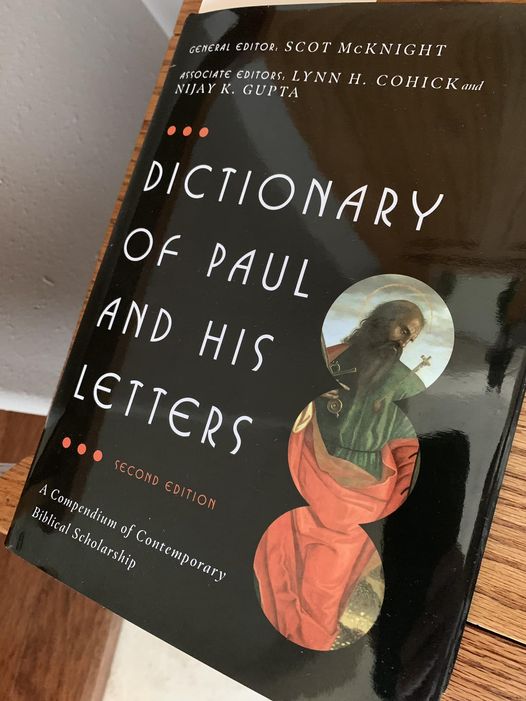
So I was interested this week in a number of my friends and acquaintances announcing the publication of the second edition of InterVarsity Press’ Dictionary of Paul and His Letters. Each was appropriately happy to see the articles that they had written in print. I thought back to the original edition of the Dictionary of Jesus and the Gospels, then the Dictionary of Paul and His Letters, and finally the Dictionary of the Latter New Testament, in all of which I had articles. All were edited (along with a co-editor) by Ralph Martin, from the generation before me at Manchester University, whom I knew well and with whom I was co-editor of that third volume. Those were indeed good times with great conversations enjoyed with faithful colleagues. But the announcements of this publication were to me a reminder that those days are memories of the past. By eyes are already on prayer and worship and sacramental ministry, already turned beyond this age to the coming age that is breaking into this one. My work is already fading, pushed onto and perhaps off the forgotten shelves of libraries, for those who have used it in the past as in the twilight of their careers and for those who are active in their careers my oeuvre is replaced by or quickly being replaced by that of others. And that is good for me.
Jesus said to set our eyes on things above, that is on the coming age now breaking into the world. He called people who forsook perfectly good careers for a rather insecure career of following him and then itinerant ministry to the nascent Church (after his resurrection). Biblical studies can indeed help one draw closer to Jesus – it was through this and the associated study of the spiritual classics that that happened to me – yet the time came for me when he implicitly said, I want you more identified with me. It was almost as if he said, “Your name is Peter. Do you love me more than these (in my case, these books and studies)?” And I have received the gift of time in relative obscurity in my “hermitage” to live out that conformity to the person of Christ, to grow in love, and to let prayer and worship become the runway for my transition to a new phase of life at one with him, what the Eastern Church calls divinization (for 2 Pet 1). It is a gift.
So my prayer for my friends is that they enjoy their ministry as biblical scholars thoroughly, that they absorb from it the lessons that our Lord is teaching them, but that they also realize that this too will pass, that there is, as C S Lewis also said, an eventual call to come “further in and higher up.” And in that I rejoice.
I take my title from an Old Testament prophetic judgment oracle in which God is rejecting the religious practices of the “sinners” because it needs to include social justice as well. The truth is that God’s perspective is wider than ours so his justice and timing will look different than ours.
This past week included the first anniversary of the Russian invasion of Ukraine. Now while a lower scale insurgency supported by Russia had been going on for something like 9 years, this was the point in time that Russian military units openly crossed the border. Any semblance of peace ended.
The response of Christians has been prayer and at least humanitarian assistance (the civilians who are suffering are Ukrainian however one evaluates the invasion). The Pope has repeatedly called for prayer as well as called leaders on both sides to peace. The Patriarch of Constantinople has called for prayer for peace. Those in evangelical, Byzantine Catholic, Ukrainian Catholic, and Ukrainian Orthodox communions have prayed for peace (including many clergy in parishes under the Patriarch of Moscow, both in the Ukraine and in Russia, although more quietly of necessity). The list could go on in Europe and North America and around the world. I personally pray for peace in the Ukraine before every mass and twice within every Divine Liturgy (I am bi-ritual). One cannot say that people are not praying. Still the war goes on as military casualties mount to six figures and more on both sides. Still the preparations for more war go on as President Putin shows no sign of seeking anything less than total victory and so prepares large number of conscripts for future battles and obtains military hardware and design from China, Iran, and North Korea at the least, and also as Ukraine asks for and obtains ever greater amounts of military equipment and supplies from the West. Russia has threatened the use of nuclear weapons – at least obliquely – and the USA has said it would counterstrike as needed. What good have all those prayers done?
It was in this context that I was reminded of the Old Testament prophets. Prophets like Isaiah, Jeremiah, and Ezekiel prayer for their people who were in a conflict with first Assyria and then Babylon, clearly the underdogs of a foreign aggressor. At least they prayed until they were told to stop praying. God often points out two things: (1) that Israel/Judah needs to repent, that that is his agenda (and the sins of the aggressor are a much lesser theme), and (2) that he will restore and bring peace to Israel/Judah after defeat and will give the aggressor nations their due payback, but will do it in his own way and time. What is clear is that God’s perspective includes both the aggressor nations and those who will eventually defeat them, and the smaller nations that they are gobbling up on every side, and Israel/Judah, in particular their faithfulness to his covenant with them and their witness to the nations. It also includes a divinely appointed ruler who will rule over all nations. It is also clear that the prophets themselves will not live to see their visions fulfilled. Isaiah sees the destruction of Israel and at least one divine defeat of Assyria but tradition has it that he was martyred by a king who would himself be taken captive by Babylon. Ezekiel hears of the fall of Jerusalem, but he dies before the return from Babylon. Jeremiah is forced into exile in Egypt by those involved in a final rebellion of Judahites against Babylon and there he dies. It takes time in our universe for God to work out his grand scheme of setting things right. His faithful ones, e.g. the prophets, trust him even when they see things getting worse rather than better.
As I have been praying I do not present to have received a revelation like the prophets, but certain some impressions that are related to the prophets. My job is to pray for peace, for that is God’s ultimate will, and to pray for the repentance of those perpetrating the evil rather than praying for their death, for that is also the heart of God, and to pray that he in his providence will provide and care for those caught up in the conflict – that it will ultimately be for their good, although I may never see it and they may never understand it. But I need to be prepared inwardly for the possibility that it may get worse before it gets better, that it may or may not be resolved within my lifetime, and it could even become intercontinental even if no missiles are used. The financial exhaustion of the West and/or the splitting of alliances would indeed be devastating, among many possible scenarios. President Putin is not entirely wrong in talking about the corruption of the West, although he may be less than accurate in what the corruption is and certainly out of place in critiquing the West before rooting out wrongs within Russia.
In other words, I need to be inwardly prepared to accept whatever God’s providence allows, for I am not God and do not understand how his grand scheme affects West and East, let alone the rest of the world. I pray for peace and for repentance in both West and East. I pray more for trust in the divine will, active or passive. I pray “your kingdom come, your will be done,” not “my/our will be done.” That is the way of Jesus.
This is a good reflection for Lent. We cannot tell God what to do, but God may well be telling us what to do in our lives (where we have some control) and requiring us to trust him with what he is doing in the wider world.
Greetings to each of you as we await celebrating the birth of Jesus and his second coming.
Judy writes “It seemed to take 2021 to climb back up out of the pandemic isolation and the knee replacement for me. Just as we were about to get on our feet again, our lives took a very different turn on November 12th, 2021. A pastor and his family from the Seattle area, who were dealing with an accident near Austin in which the wife had destroyed her ankle, moved in with us along with the wife’s mother who came to help care for the children, aged two and seven. At the time, the wife was in the hospital having surgery and we thought that they might be with us for a couple months. Well, six surgeries later and 8 months later, they moved out into their own home in Belton, Texas a 35-minute drive from here and are beginning all over again. (They had been taking a 3-month trip traveling around the US through every State when this accident happened.) Peter was a Facebook friend with the grandfather in this family and Peter responded to his post about his daughter’s being in an accident in the Austin, TX area. Within four days, they had moved in. The wife is still walking with a crutch and her ankle is fused with two steel rods inside attached to a bone graft. She is still doing physical therapy. The time, a Divine Appointment, in many ways was very formative and healing for them, but it got very tiring for me. In fact, on June 1st, I got the flu which turned into pneumonia. I was very sick for two months, which was probably contributed to by the exhaustion which I was feeling after 8 months with this family in our home.”
While the Dominican Sisters were away the end of July, Peter took the opportunity to visit his brother in Maryland. John turned 80 this November, a day after Peter turned 75, and at that age one must grasp such opportunities. On his return trip, probably in an airport, Peter contracted COVID and a few days later Judy came down with it as well. Paxlovid (and vaccination) made this a shorter and lighter sickness than it could have been, but Judy was still under the weather from the flu and pneumonia. Judy continues, “A real ‘downer’ came when Covid kept Peter and I from attending my aunt’s funeral. She had made it to 100 years old and this was really a celebration of a life well lived. She was the last of that generation in my family.”
“So, when Christmas of 2021 rolled around, we were very busy planning a celebration for Christmas for seven people. We had a lively time with two small children in the house: it was a very joyful occasion. The grandfather arrived for New Years and stayed 10 days with us, which made us a family of 8. Peter and he had many theological discussions; and he has since come to the fulness of faith, entering the Catholic Church back home in Vancouver.”
“The war in Ukraine has also been occupying our attention. I have been zooming with a friend who left her husband, (who was mandated not to leave the country) in Lviv and escaped with her 12-year-old son to Warsaw, Poland, where she is staying with a friend. Peter has become involved with a previous student from ETF Osiejek Croatia who lives in Ukraine with his family. We are trying to help both these struggling families. We are praying for peace.”
Both Peter and I find ourselves aging and trying to deal with this gracefully; but I am finding it a real challenge. I need a second knee replacement. I also have a frozen right shoulder. But we have many gifts in our lives- especially that of family. October brought a real gift: the highlight of my year, a birthday visit from our daughter Elaine, a physical trainer, and her eldest daughter, Caitlin, a professional photographer, aged 25, from Calgary, AB, Canada.
Judy’s sister, Elaine with our daughter, Elaine
Our daughter, Elaine and her daughter, Caitlin
We had fun treating Canadians to a Mexican and a Cajun meal. This was a very special time.
Peter has continued as chaplain to the Dominican Sisters of Mary Mother of the Eucharist here in Georgetown. He also is the priest for a Byzantine Catholic Community in Austin, since he is
bi-ritual. He helps in parishes in the local deanery. He has basically retired from involvement in biblical studies so he can focus on prayer and ministry, although he took part in and read a paper at a conference at Lanier Theological Library sponsored by the International Library for Biblical Research. Another part of the ministry is leading a cell group for the Domestic expression of the Brothers and Sisters of Charity in the Austin area. Of course, he attended the Priests Assemblies of both the Diocese of Austin and his home diocese, the Personal Ordinariate of the Chair of St Peter.
This has been a year for deaths: besides the loss of Judy’s aunt, Peter has lost a former dean from Trinity Episcopal School for Ministry, a faculty colleague from Regent College, a rector he supplied for in Calais ME, and others. This month we both went to the funeral of our BSCD friend of 10 years David Dickinson, a model of godly servanthood, who was 13 years younger than Peter (David and Gina were members of the cell group we were part of at St Clare Monastery in Houston). Those events keep us focused on what is meaningful in life and where to keep one’s focus.
So, we are back to Christmas again and we will rejoice in Father God’s gift of his Son, Jesus, the greatest gift that the world has ever known. Have a joyful and blessed Christmas, celebrating!









 Fr Peter's Reflections